
Hello again! After a long paternity leave*, I’m happy to be back.
This week we’re following up on the Ebola outbreak, which I last covered way back in July. Back then, I covered why the outbreak was “out of control” across eastern Democratic Republic of the Congo, and why it would, as I wrote, “likely become the largest Ebola outbreak on record.”
So, how has that analysis held up? Unfortunately, quite well.
Four Months Later
In the last few months, the outbreak has grown dramatically.
The biggest headlines have been about the cases that have spread abroad to Kenya, France and Nigeria. That sounds scary (and we should continue to expect more cases to turn up abroad) though international cases are very unlikely to spark larger outbreaks. As I wrote back in May, when the outbreak was first declared, “Ebola is simply not the type of disease that can spiral unchecked in any country with a semi-competent health system.”
(What I am worried about is potential future spread into South Sudan or the Central African Republic.)
Still, the real catastrophe remains in Congo, where the outbreak is already the second deadliest in history. The official toll, almost certainly an undercount, exceeds 11,000 cases and 5,000 deaths. But those topline numbers obscure just how dire the situation is.
Consider instead two other figures, which the WHO updated most recently last week. They are that:
Right now, only 30 percent of Ebola deaths are happening in treatment facilities, and…
Just 15 percent of new Ebola cases involve people already identified as contacts of infected patients.
These stats remain almost unmoved since July, which is a disaster. Because what they show is that despite the last four months of the emergency response, most Ebola victims are still dying and spreading the disease unchecked, and that responders are still being blindsided by the vast majority of new infections. The disease is simply spreading as fast (or faster) than our efforts to control it.
We’ll dig into what’s going so wrong in my next update on Ebola. I am doing more reporting on this.
(For now, consider this damning assessment from Doctors Without Borders president Dr. Javid Abdelmoneim. He’s gone on record to warn that the response itself is failing, not simply struggling against a difficult outbreak and circumstances. “Our teams are often left speechless by the dysfunctions they witness in many areas,” he said. “Despite the vast amounts of money provided for the response, many frontline responders are left trying to contain the outbreak with empty hands and empty pockets.”)
Today, though, I want to focus on what may be our single best chance of turning the tide against this outbreak next year: a vaccine.
The Four-Way Race for a Vaccine
As a quick reminder, Ebola vaccines already exist… but only for the more common Zaire strain. This ongoing outbreak is caused by the rarer Bundibugyo strain, for which we still have no vaccine or treatment.
We’re going to cover the four leading vaccine candidates in development, three of which are slated to be in human clinical trials in Congo by the end of this month.
I spoke with Dr. Jean-Pierre Van geertruyden, an epidemiologist at the University of Antwerp who is co-leading the human vaccine trials in Congo. I also spoke with Dr. Julien Potet, an infectious disease researcher with Doctors Without Borders, about what it will take to get an effective vaccine to the people who need it.
The trial Van geertruyden is helping lead is called Tumaini, which means ‘hope’ in Kiswahili. It began in October and is designed to test several vaccines in a single study, primarily by vaccinating people who have been in contact with Ebola patients and tracking whether they become sick too. How many vaccines will ultimately be tested remains an open question, with new candidates added to the study as they become available.
It’s a double-blind trial, meaning neither the participants nor the researchers know who initially receives an experimental Ebola vaccine or who receives a semi-placebo vaccine (which inoculates against typhoid fever) for comparison. If that sounds cruel, there’s an important ethical safeguard: after 29 days, everyone in the control group is offered an Ebola vaccine candidate, too. That way nobody is permanently denied the chance of protection.
The trial is an incredible feat of logistics. Van geertruyden told me it uses “the first mobile lab in the world that can be airlifted, and which can do whole genome sequencing on the spot,” he said. “So we’re learning a lot on all levels,” he said, including lessons that could help researchers respond faster to future outbreaks.
Anyway, let’s introduce our candidates, with one caveat up front: it is too early to know which of these might work, or how well. The trials are at the very beginning, and both experts were understandably reluctant to venture guesses about future results.
(Note: The first three candidates have wonderfully long, gobbledygook names like rVSVΔG-BDBV-GP and ChAdOx1-BDBV-GP, so I’m just calling them by the names of the research organizations developing them.)
Vaccine Candidate #1: IAVI
I want to start with this one, because the story is fairly wild.
Back in 2013, American researchers tested an experimental vaccine against the Bundibugyo strain in monkeys. It was one of the first studies for any vaccine against this strain of Ebola, and the results were, frankly, incredible: a single dose protected every vaccinated animal.
But that was more than a decade ago. And despite those promising results, the vaccine never advanced toward human trials… until this year.
What makes that lost decade especially frustrating is that the technology behind the vaccine has since been proven to work. It’s the same technology used in Ervebo, the highly effective vaccine against the more common Zaire strain of Ebola. The early results and its proven tech are also why, when the current outbreak began in May, the World Health Organization identified it as the most promising candidate.
Yet this vaccine candidate is the furthest behind of the four we’re looking at. We shouldn’t expect to see it entering the Tumaini trial until sometime next year.
So, what happened? Well, the original reason the research languished was money. Bundibugyo has historically attracted little attention or investment.
As for why it is still taking so long to catch up? I reached out to the International AIDS Vaccine Initiative (IAVI), the nonprofit that is now developing the vaccine, to ask why it’s moving more slowly than the other candidates. Is the issue still finances?
No. A spokesperson at IAVI instead pointed to technical complexity, explaining that developing this type of vaccine is particularly time-consuming.
Feel free to skip ahead, but if you’re curious about the details: right now IAVI is working to turn the experimental, research-grade vaccine into an early stock of virus that will eventually form the basis for manufacturing. That requires “multiple rounds of purification and characterization” to determine the best conditions for producing the vaccine virus at the intended dose. Those steps, the spokesperson acknowledged, “have been more time consuming than we anticipated when we began work on the virus.”
Fair enough! That’s the nature of experimental science, and historically, this vaccine is still developing remarkably fast, even if slower than some other candidates.
Vaccine Candidate #2: Oxford
Candidate two is being developed by the University of Oxford, and has moved shockingly fast. It uses the same technology as the Oxford/AstraZeneca COVID-19 vaccine. This is called ‘viral vector’, which modifies a harmless, unrelated virus to deliver instructions for an Ebola protein. This teaches the immune system to recognize that protein, and prepares it to fight the real virus if it ever encounters it.
Researchers launched their Phase 1 trial for this vaccine (which largely tests for safety and a general immune response) in July, just two months after the outbreak began. Better still, over 600,000 doses have already been manufactured, and are ready to deploy if the vaccine proves effective.
Oxford’s vaccine candidate is now preparing to enter Phase 2 and 3 in the larger Tumaini trial in Congo by the end of the month. These phases mean it will finally test whether it actually prevents Ebola and what dose is needed.
Another major advantage: it’s expected to need only ordinary refrigeration, between 2°C and 8°C. That’s a big deal when you’re trying to get vaccines into remote communities without electrification, sometimes by truck or on foot.
Vaccine Candidate #3: Moderna
Moderna’s vaccine candidate takes a different approach. It uses the same revolutionary mRNA technology behind Moderna’s COVID-19 vaccine. Rather than introducing a virus, it gives the body’s cells temporary instructions to produce an Ebola protein. Still, the end result is the same: training the immune system to recognize and fight the real virus.
Moderna began Phase 1 safety trials in August and, like Oxford, is also planned to enter Phase 2 and 3 in the larger Tumaini trial in Congo this month.
It’s worth noting that Moderna has also received substantially more development funding for its vaccine: $58.5 million from CEPI, an international partnership created in the wake of the West African Ebola epidemic to speed up vaccine development. Oxford, by comparison, received just $13.9 million. (My understanding is that Moderna’s vaccine is simply more expensive to develop.)
But it has at least one potential disadvantage. The vaccine will need to be kept frozen, at around -20°C or colder, potentially making distribution more difficult.
Moderna says it’ll make at least 500,000 doses, available at special discounted prices, but hasn’t publicly specified what those prices will be or when the doses will be produced.
Vaccine Candidate #4: Ervebo
Finally, let’s return to Ervebo, the already-approved vaccine I mentioned earlier. It was first tested during the 2014–2016 outbreak in West Africa, eastern Congo during the 2018–2020 outbreak, and most recently, central Congo during last year’s outbreak.
Although it was designed for a different virus, there’s growing evidence that it might also offer some protection against the Bundibugyo strain. Animal studies have shown encouraging results, and physicians working with Doctors Without Borders have noticed signs that people previously vaccinated with Ervebo may be less likely to become sick or die from Bundibugyo.
Potet tells me there are at least three research projects currently ongoing that are testing Ervebo:
The Tumaini trials Van geertruyden is co-leading
A trial called BRAVO that’s following newly vaccinated frontline health workers, and
Several research teams are simultaneously gauging how some of the roughly 350,000 people who previously received Ervebo years ago in eastern Congo are faring today.
Granted, if Ervebo offered something like complete protection against Bundibugyo, we’d likely already know. But even partial protection could save lives and help bring this outbreak under control.
“It will not be the perfect solution,” Potet told me, “but it may contribute.”
Hit the Ground Running
So, let’s get to the point. When might we actually have a working vaccine?
If all goes exceptionally well, we could have one as early as the first quarter of 2027, says Van geertruyden. He stressed that this is a best-case scenario, and entirely dependent on at least one of the candidates proving highly effective. (Absolutely not a given.)
Although that is still months away at best, Van geertruyden was also quick to point out just how fast vaccine research has moved since the outbreak began in May. Getting multiple experimental vaccines into a single trial in just a few months required coordinating manufacturers, researchers, funders and regulators across several countries. This, all while assembling a ground team amidst the overstretched, failing health system in the Congo.
“I think it’s a miracle that we started so soon,” he told me. When I pressed him, he told me he’d originally expected the trials to begin two months later, and even that, he said, would have been remarkably fast.
Let’s assume one of these vaccines works, and I think that’s a very reasonable bet. What happens next?
Well, as Potet emphasized to me, an effective vaccine will only be as useful as our ability to get it to the people who need it.
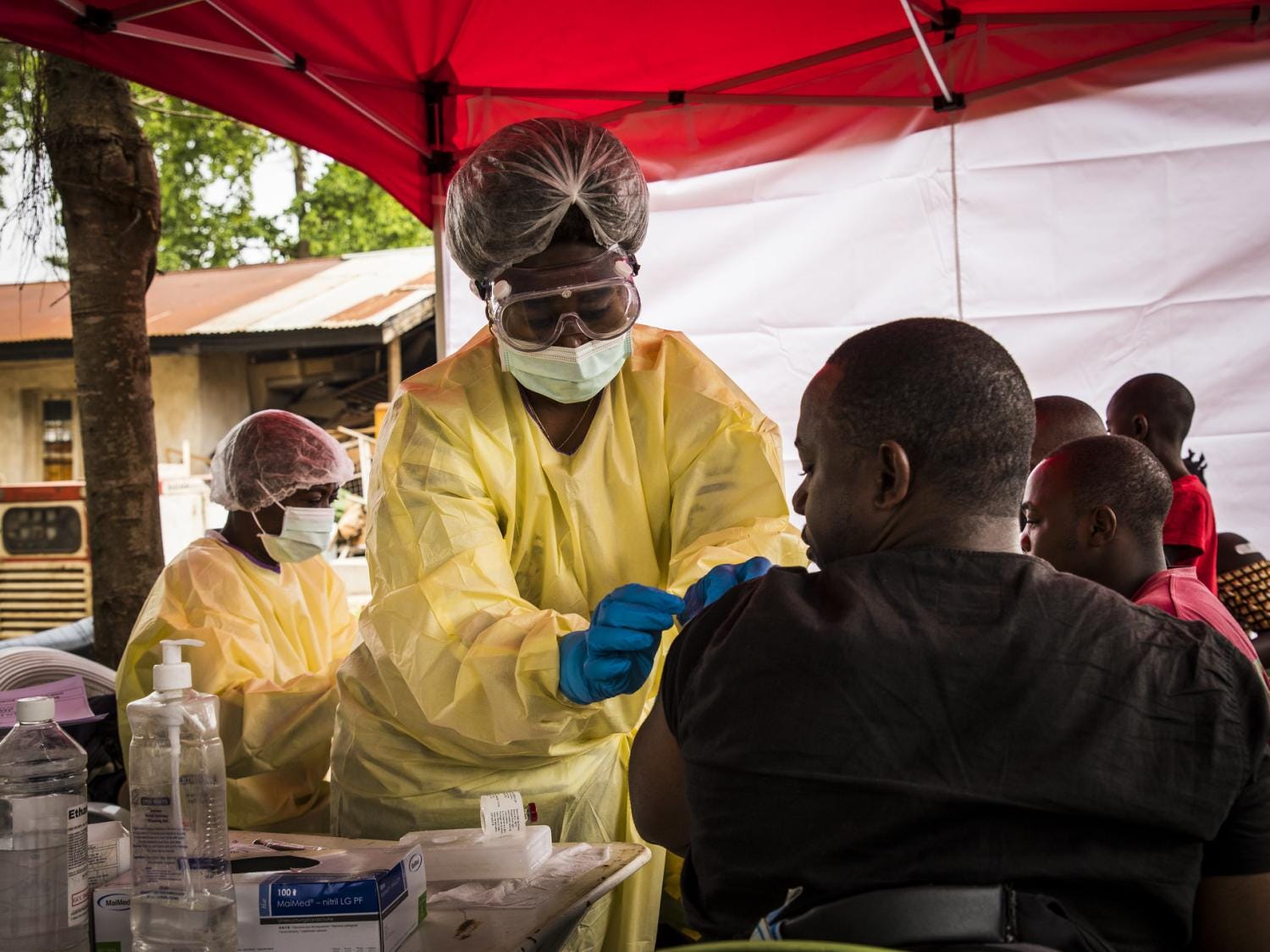
The most efficient approach is called ring vaccination, which was used successfully during the last major Ebola outbreak in eastern Congo. The idea is simple: find someone infected, identify the people they’ve been in contact with, and vaccinate those people and their close contacts to stop the virus from spreading.
But remember, contact tracing is one of the biggest failures of the current response. Just 15 percent of new Ebola cases involve people previously identified as contacts, and ring vaccination won’t work if the vast majority of cases are happening in the dark. “That is my biggest message,” Potet told me, “the problem that we have in this outbreak is contact tracing.”
Does that mean the vaccination effort is already hobbled? Not exactly.
Potet pointed out that even if contact tracing remains inadequate, there are alternative approaches to vaccination campaigns, including vaccinating entire geographic areas around known cases.
It’s also worth asking: what if the trials show that none of these vaccines work? Should we expect Ebola to keep spreading exponentially, eventually infecting millions?
Not at this point, no.
Potet reminded me that during the record-breaking Ebola outbreak in West Africa from 2014 to 2016, there were many dire projections about millions of cases that never materialized.
A vaccine did ultimately protect people toward the end, but it didn’t bring the outbreak under control. Importantly, communities changed their behavior as they came to understand the threat of the growing outbreak, and the response improved. (And then there’s the grimmer reality that Ebola can eventually burn through the people most likely to be exposed, leaving it with fewer opportunities to spread.)
So it’s worth remembering that even without a vaccine, the trajectory we’re on today isn’t necessarily the one we’ll be on six months from now.
Still, a working vaccine could help change that trajectory much sooner, and spare an enormous amount of death and suffering along the way.
*My second daughter was born mid-September!