
This week, I want to follow up on the Ebola outbreak in eastern Democratic Republic of the Congo, where there have been more than a few major developments. I’ll run through the most recent ones quickly:
On Monday, Reuters reported that researchers had begun the first human trials of a vaccine for this strain of Ebola. (The trial is only testing safety for now, making sure 50 people in Oxford, UK, do not suffer serious side effects.)
Healthcare workers—from epidemiologists to gravediggers—have begun striking at several facilities in the outbreak’s epicenter because they have not been paid for months, Al Jazeera reported Wednesday.
Since we last covered the outbreak, researchers have raised concerns that this rare strain of Ebola may spread with milder symptoms in some cases, reported The New York Times. (This may sound like good news, but it isn’t. It means more opportunities for the virus to spread unnoticed.)
And the disease has reached two new, highly vulnerable provinces in DRC, Haut-Uélé and Tshopo.
But by far the biggest development is just where this outbreak is headed. One month ago I described it as “out of control,” which is still true. Now, if the current trajectory holds, it will also likely become the largest Ebola outbreak on record.
This should not be so surprising. Africa CDC (which is co-leading the control effort) warned a month ago that this was possible. And the World Health Organization (the other co-leader) also just announced that the disease is already spreading faster than any Ebola outbreak in history.
To be clear, we’re not there yet. So far the confirmed death toll from this outbreak—more than 700—makes this the third-deadliest Ebola outbreak on record. But that’s still only one-fifteenth of the toll from the 2013 West Africa outbreak, the deadliest in history.
But deaths alone understate how badly the response is going. Instead, there’s a better benchmark that shows just how little control responders currently have over the virus.
Still in the shadows
According to Africa CDC, the benchmark for whether a control effort is staying ahead of the outbreak, rather than chasing it, has to do with how much of the spread is traceable. It’s that at least 80 percent of new cases should appear among people responders had already identified and were monitoring, rather than being discovered only after someone becomes sick.
Unfortunately, we’re at the exact opposite point. As Dr. Chikwe Ihekweazu at the WHO recently warned that “80 per cent of new cases” are instead “coming to us from unknown chains of transmission.”
Because there’s no vaccine or effective medicine for a disease like this, defeating it depends almost entirely on finding cases quickly, isolating them and tracing everyone they may have exposed. (We have already covered why eastern DRC is arguably the hardest place in the world to do that.)
Another way of thinking about it: consider that while the official case count passed 2,000 this week, both the experts leading the response and independent models estimate that the true count may be two to four times higher. That’s pretty stark. If the response is missing somewhere between half and three-quarters of all cases, then it is also missing most opportunities to isolate patients, trace and monitor the people they exposed, disinfect contaminated spaces, and, ultimately, dispose of infected bodies through safe burials. (In DRC, many infections are passed through the ritualistic washing of dead bodies in preparation for burial.)
So, my biggest question is what, exactly, is driving this historic surge? We have already covered why conflict, mistrust and dysfunctional health systems make eastern DRC such punishing terrain for an Ebola response. But many of those same problems were present in 2018, when a similar outbreak was contained with fewer cases than this one likely has now. What is so different this time?
To tackle that question, I called Paul Spiegel, director of the Johns Hopkins Center for Humanitarian Health. I’ve spoken with Spiegel several times before; he has spent decades studying and responding to health crises in conflict zones, and few people have a better macro view of a disaster like this one than him.
So what’s going (historically) wrong?
To start, let’s dispense with the most obvious explanation for why things have gotten so much worse: that the people in charge are screwing up the response.
Spiegel says that is clearly not the case. “I think the WHO and Africa CDC are doing well,” he told me, particularly in coordinating the various organizations involved in the response, and prioritizing scarce staff and supplies where they are most needed. Of course, that does not mean the response is adequate to the crisis… it’s clearly not. Just that the limited resources available are being used as effectively as anyone could reasonably expect.
Nor did Spiegel place the blame on Congolese authorities, whom he described as “very competent in responding to the outbreak.” After all, DRC has more experience fighting Ebola than any country in the world. This is its 17th outbreak since the virus was identified in 1976.
And as we’ve covered before, this also does not look like a story of rich countries merely refusing to offer enough money. Significant money has been pledged. (Although, as the medical strikes mentioned above show, actually getting that money where it is needed is far more complicated. And we’ll see if international generosity holds as the response grows into a multibillion-dollar operation.)
Instead, the problems all circle the daunting work of restricting people’s movements and modifying behavior in eastern DRC. And the variety of challenges facing this work is hard to overstate: there is active insurgency and fighting in several of these provinces. In fact, in the three worst hit provinces (Ituri, North Kivu and South Kivu) five million people were already displaced from their homes before the Ebola outbreak.
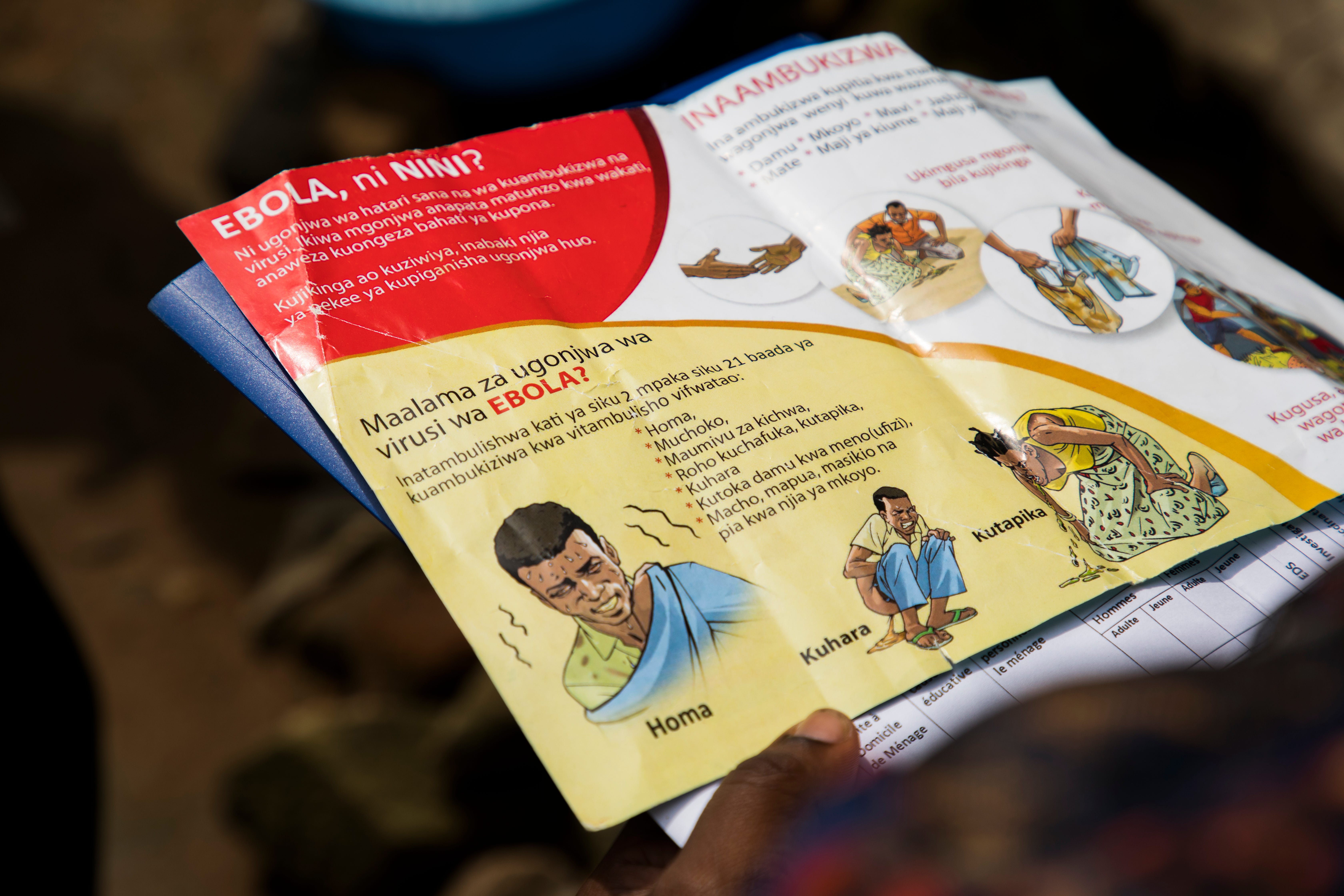
Many communities are also awash in misinformation, including doubts that the outbreak is even real, and have good reason to mistrust both their government and foreign interlopers. Consider this March 2026 UN report, which documented 425 human-rights violations over a three month period by Congolese government forces, in the three regions mentioned above. After years of mistreatment and violence by authorities, expecting more of the same is hardly irrational. And you can understand why someone might resist naming every person they have recently seen, or surrendering the care or body of someone they love, all for a reason they may not even believe.
Spiegel also described the anger and resentment that builds when the “big white UN cars” arrive for acute crises like Ebola, then seemingly disappear while people continue dying from everything else. From the local perspective, it’s easy to interpret that outsiders “only come in when [they] care about the potential for an outbreak to spread elsewhere,” he explained. (Neither of us agree this is the full picture, but I think it’s a fair point!)
Still, much of that was also true in 2018. So again, why is this outbreak historically worse? Spiegel’s honest answer was that we can’t yet know. There are several changes over the last decade that have altered the dynamics of an already extraordinarily difficult region.
Certainly, some of the ongoing conflicts are worse. For example, the Rwandan-backed M23 rebel group now controls territory in North and South Kivu that operates “almost like a different country,” complete with borders and checkpoints, he said. That includes areas, like the regional metropolis of Goma, that served as the headquarters of the 2018 Ebola response. And moving people and material through these territories is deeply challenging.
Misinformation has also intensified globally, and eastern DRC has not been immune. This BBC article dives into the intensity of today’s misinformation, which is wild.
This outbreak’s epicenter is a chaotic mining area, with people constantly moving in and out, which carries particular challenges to tracing infections and keeping exposed people under watch.
And Spiegel stressed that, certainly, unlike in 2018, responders have neither an effective treatment nor a vaccine, because this is the rarer Bundibugyo strain.
Lastly, the outbreak appears to have gone undetected for weeks, perhaps months, for reasons that remain unclear. Possible explanations include early cases being mistaken for tuberculosis, the milder symptoms described above allowing infections to pass unnoticed, and the nonfunctional state of laboratories in rebel-held Goma.
So, ultimately, the answer to why the 2018 outbreak tipped toward control, while this one keeps spiraling… well, it’s probably found somewhere in this messy, non-exhaustive combination of factors.
Exponential trouble
I also asked Spiegel about a larger problem: what should we expect to change once an outbreak like this crosses into historic territory? It’s an important question because—without getting too in-the-weeds—some medical demands scale roughly in a straight line. For example, twice as many patients require roughly twice as much medicine, for roughly twice the cost.
But other parts of a response become exponentially more difficult once the existing system is overwhelmed. Imagine a laboratory that can, at first, process twice as many tests for roughly twice the cost. Eventually, it hits capacity. At that point, you need another laboratory, more equipment and more technicians just to keep up.
Ebola creates these exponential pressures everywhere, because every new case can create another circle of people who must be found and monitored for 21 days, rapidly meeting the limits of laboratories, treatment centers and tracing teams.
Unfortunately, Spiegel believes we have already crossed that threshold. “Sadly, we’re at that point now,” he told me. “At one point, there are just so many cases that the classic way of trying to contain and control is overwhelmed,” Spiegel said. “We’re there now. Not out front, we’re actually quite behind,” he said.
The takeaway is that we’re now looking down the barrel of a massive need to increase resources for this response. And getting international groups to pledge more money is only a fraction of the problem. Yes, “you need a significant increase in laboratories and treatment centers,” he said. “It’s all of that, but it’s not just [infrastructure]. It’s actually a lot of asks in terms of the community. You’re going to have to significantly increase contact tracers and community outreach and health workers,” he said. “And that’s going to require more training, because you have to hire way more people who haven’t necessarily been trained.”
There are some grim implications here, because none of these systems can be expanded, or these people hired, overnight.
So what’s the outlook from here?
Spiegel and I discussed three factors that could still shape where this outbreak goes. Let me present them in ascending order of darkness:
The most hopeful is better medical tools. An effective treatment or vaccine could turn around the spiraling trajectory of the response; especially if it was used to protect medical and community responders. To this end, the vaccine trial announced this week is moving unusually quickly, which is, at the very least, hopeful. “The good news, at least, is that they are moving forward now,” Spiegel said. “Maybe that can make a difference, but it depends on the efficacy and the effectiveness,” of what’s ultimately developed.
The response itself can also improve with more funding and focus, and as communities are won over: this means more workers, labs and treatment centers, better access to hard-to-reach communities, and, somehow, greater trust. Trust is, after all, the ultimate currency for population management and control.
…but all of that takes time, and the outbreak may just continue expanding as fast or faster than the response can grow. As Spiegel put it, trust must be built “before an outbreak occurs, not during it. We’re already behind on that.”The darkest possibility is that the outbreak simply burns itself out in the hardest-to-reach communities, leaving untold thousands dead. Epidemics sometimes do, Spiegel said, “despite all of our best intentions and tendency to think that we had a major effect.”
And let me leave you with one final, even bleaker point: Ebola deaths will capture only part of the damage. Spiegel noted that these outbreaks keep pregnant women, sick children and everyone else away from clinics, while the response pulls scarce workers and resources away from treatment for malaria, respiratory infections and diarrhea. (The three big killers in this part of the world.) As Spiegel warned, these wider disruptions will almost certainly kill more people than Ebola itself.
That’s all for now.
-Wm